Rust to Reboot: Inside the Old Lansing Factory Buildings Now Housing the City's Next Big Ideas
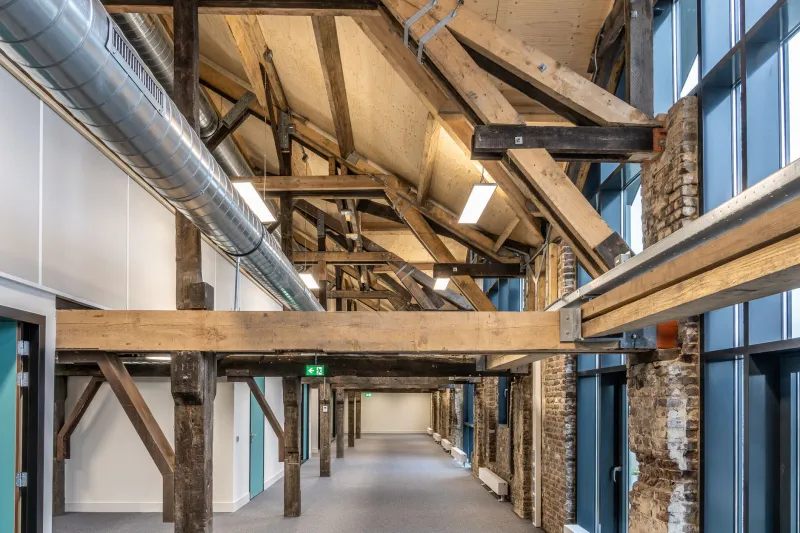
Walk into certain corners of Lansing and you'll notice something strange happening. The smell of machine oil hasn't entirely left the walls. Exposed brick still bears the scorch marks of a century of manufacturing. Overhead cranes sit frozen above concrete floors that once rattled with assembly-line energy. But pull up a chair at one of the long communal tables now filling these spaces, and you'll find a software developer debugging code, a product designer stress-testing a prototype, or a startup founder pitching investors over a video call.
Lansing's industrial past isn't dead. It's just been rebooted.
The Buildings Nobody Wanted (Until They Did)
For years, many of Lansing's old factory buildings sat in an awkward limbo — too expensive to demolish, too complicated to redevelop, and too far off the radar of the suburban office-park crowd to attract mainstream tenants. They were remnants of a manufacturing economy that had shifted, restructured, and in many cases, moved on entirely.
But that same awkwardness turned out to be an asset. The buildings were affordable. They had bones that newer construction simply couldn't replicate — soaring ceilings, thick walls, loading docks, and floor plans wide enough to fit pretty much anything you could dream up. For a scrappy entrepreneur or a small tech team that didn't want to blow half their runway on rent, that math made a lot of sense.
"I looked at a few of those newer co-working spots and they felt like airport lounges," says Marcus Thibodeau, who co-founded a hardware prototyping company and set up shop in a converted machine shop on the near east side. "There's nothing wrong with them, but they're not built for what we do. We needed space to make noise, make messes, and make actual things. This building gets that."
Marcus isn't alone in that thinking. Across Lansing, a loose network of entrepreneurs, artists, engineers, and makers has quietly colonized the city's leftover industrial real estate — and the results are starting to turn heads.
What a Tech Hub Looks Like When It Has History
One of the more striking transformations is happening inside a former light-manufacturing facility that now operates as a multi-tenant innovation hub. The original structure dates back to the mid-20th century, and whoever did the renovation made the smart call to leave most of the character intact. The loading bay doors still open. The old freight elevator still works. The skylights that once gave factory workers natural light now flood a cluster of standing desks and 3D printers with the same glow.
Tenants here include a small robotics startup, a freelance collective of UX designers, and a woman-owned leather goods business that uses a corner of the space as both a workshop and a pop-up retail spot on weekends. It's an unlikely mix, but that's kind of the point.
"There's something that happens when you put different kinds of makers in the same building," says Priya Okonkwo, who runs the leather goods operation. "I've had conversations with the robotics guys that gave me ideas about tooling I never would have thought of on my own. You can't really engineer that kind of collision in a strip mall."
That cross-pollination is showing up elsewhere in the city too. Several of Lansing's emerging maker spaces have started hosting open shop nights — evenings where anyone with a project and a willingness to share what they're working on can come in, use the equipment, and swap ideas with whoever else shows up. It's informal, occasionally chaotic, and by most accounts, genuinely valuable.
The Economics Actually Work
It's worth being honest about why this is happening now, not ten years ago. Rents in Lansing's more conventional commercial corridors have climbed. Remote and hybrid work has made the traditional office lease a harder sell for small teams. And a new generation of entrepreneurs — many of them with Michigan State connections — is actively looking for spaces that reflect their values rather than just their square footage needs.
Old industrial buildings check a lot of those boxes. They're often located in neighborhoods with walkable amenities, good highway access, and enough parking to not be a headache. The per-square-foot cost tends to undercut newer construction by a meaningful margin. And there's a certain credibility that comes with operating out of a building that looks like it's been through something — it signals seriousness without trying too hard.
"We could have gone somewhere shinier," admits Deon Castillo, who leads a small cybersecurity firm that recently moved into a converted warehouse space. "But we're not trying to impress anyone with our office. We're trying to do good work. This place lets us do that without the overhead that would have slowed us down in year one."
The city hasn't been entirely passive in all of this either. Various incentive programs and redevelopment grants have helped make some of the more ambitious adaptive reuse projects financially viable, and there's been growing recognition at the municipal level that keeping these buildings alive — and filling them with jobs — is worth the investment.
Lansing's Manufacturing DNA Is Actually a Feature
There's a cultural dimension to all of this that's easy to overlook. Lansing is, at its core, a city that knows how to build things. That identity runs deep — in the families who worked the auto plants for generations, in the technical colleges that trained machinists and engineers, in the general civic pride around making stuff with your hands.
The new wave of occupants in these old factory spaces is, in a lot of ways, tapping into that same energy. The tools are different. The outputs are different. But the mentality — show up, put in the work, make something real — maps pretty cleanly onto what the buildings were always designed to support.
"I think about that sometimes when I'm here late," says Marcus. "Whoever built this place a hundred years ago wasn't that different from us. They were trying to figure something out and they needed space to do it. We're just the next version of that."
That continuity might be the most Lansing thing about all of it. The city has never been great at erasing its past — and it turns out that's not a weakness. The industrial bones that other places might have torn down are becoming the foundation for whatever comes next. The rust belt narrative has never felt less accurate, or less interesting, than it does right now.
If you haven't wandered into one of these spaces yet, it might be time. Bring a project. Or just bring your curiosity. Either way, something's being built in there.